

The Negotiation Intelligence (NQ®) model identifies four guides that every skilled negotiator needs: the Explorer, who listens deeply and stays curious under pressure. The Inventor, who creates value rather than just dividing it. The Harvester, who converts opportunity into concrete results. And the Game Architect, the strategist who doesn’t just play the negotiation, but shapes the game.
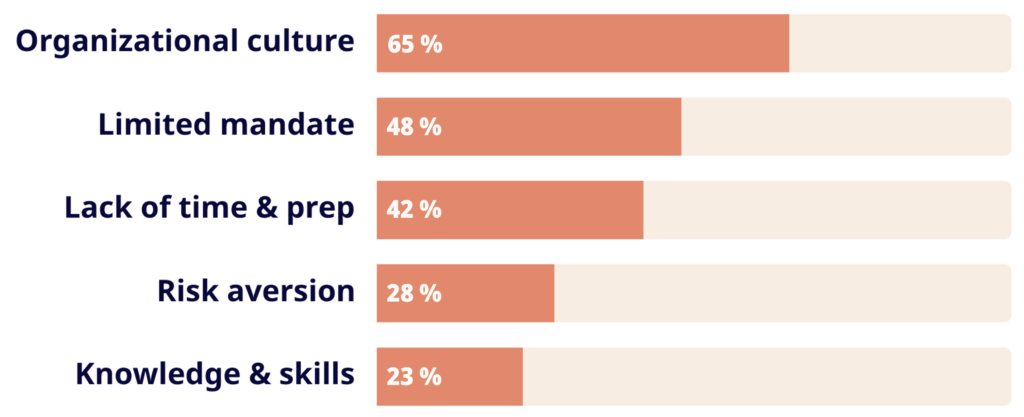
The top two barriers for the Game Architect are by a significant margin: organizational culture (65 respondents) and limited mandate (48). Together, they account for more than half of all mentions across five options.
These are not personal failures. They are the walls that block the Game Architect, the NQ® guide that matters most for anyone who wants to stop playing the negotiation and start designing it.
What a Game Architect actually does
Most negotiators focus on content: price, terms, delivery conditions, payment schedules. The Game Architect focuses on something prior to all of that. Not what is being negotiated, but how, when, with whom, and on whose terms.
Shaping the game means determining who is in the room before the conversation begins. It means setting the agenda rather than responding to one. It means treating timing, sequencing, and framing as strategic levers, not logistical details someone else handles. The Game Architect is the strategist, the visionary, the leader, and yes, sometimes the rebel. They don’t just play the negotiation well. They design the conditions under which it happens.
This is what I mean by onderhandelen omdenken negotiation rethought from the ground up. Not sharper tactics inside the same game, but a fundamentally different relationship to the game itself.
It is also, the data tells us, the role that organizations are most effectively preventing their negotiators from stepping into.
The two walls
Organizational culture was named by 65 respondents, the single largest barrier in the entire survey. And it is precisely the environment the Game Architect needs to operate in.
Shaping the game requires a culture that tolerates ambiguity, rewards strategic initiative, and gives negotiators room to challenge the frame rather than just work within it. When the culture values speed over depth, certainty over exploration, and compliance over creativity, the Game Architect’s moves are read as disruptive or naive. People learn, quickly, not to zoom out. They learn to play the game that is expected of them, and to play it efficiently.
Culture doesn’t block the Game Architect by issuing a directive. It does it by making the alternative feel unreasonable.
Limited mandate was cited by 48 respondents and it operates as a more concrete version of the same constraint. Shaping the game requires authority: the ability to influence who participates, what is on the table, when the conversation happens, and what the alternatives are. A negotiator handed a tightly defined mandate is, by definition, playing someone else’s game. They can optimize within it. They can execute it well. They cannot redesign it.
What makes this particularly acute is that mandate and culture reinforce each other. A culture that doesn’t value strategic initiative produces organizations that don’t grant strategic mandates. And negotiators operating within narrow mandates stop developing the instincts that would allow them to argue for broader ones.
The result is a system that reproduces itself and calls it professionalism.
Three conclusions worth sitting with
One: the biggest barriers to shaping the game are not inside the negotiator, they are inside the organization. This matters because most development programmes treat negotiation as an individual capability. The data suggests it is at least as much an organizational design question. What does your culture actually reward when a negotiator pushes back on the frame?
Two: the mandate is not always as fixed as it feels. Many professionals have inherited limits they have never tested. Challenging the mandate – with data, with a well-framed alternative, with a clear view of what’s at stake – is itself a Game Architect move. The boundary is sometimes a wall. Sometimes it’s a door that opens inward.
Three: shaping the game is a decision before it is a skill. The Game Architect starts with a question most negotiators never ask: who decided this was the game, and does it have to be? That question changes the preparation, the conversation, and what you are willing to put on the table. It starts long before you sit down and long before culture or mandate get the chance to stop you.

